7 Essential Customer Service Skills Every Hospitality Professional Needs
Great hospitality is about more than providing a service. It’s about making guests feel welcome, understood, and valued throughout their experience.
Whether you work in a hotel, restaurant, bar, café, resort, or another hospitality environment, strong customer service skills can make the difference between an ordinary interaction and a memorable guest experience.
The good news is that excellent customer service isn’t simply something you’re born with. These skills can be learned, practised, and strengthened through experience and effective training.
Here are seven essential customer service skills every hospitality professional should develop.
1. Clear Communication
Good communication is at the heart of hospitality.
Guests need information that is clear, accurate, and easy to understand. Whether you’re explaining a menu, answering a question, taking a reservation, or providing directions, the way you communicate can shape the guest’s impression of the entire business.
Strong hospitality professionals communicate confidently while remaining friendly and approachable.
It’s also important to adapt your communication style. A guest in a hurry may appreciate a quick, direct answer, while another guest may need more explanation or reassurance.
Clear communication reduces misunderstandings and helps guests feel confident that they’re being looked after.
2. Active Listening
Listening and actively listening are not quite the same thing.
Active listening means giving the guest your full attention and making sure you understand what they’re actually asking for before responding.
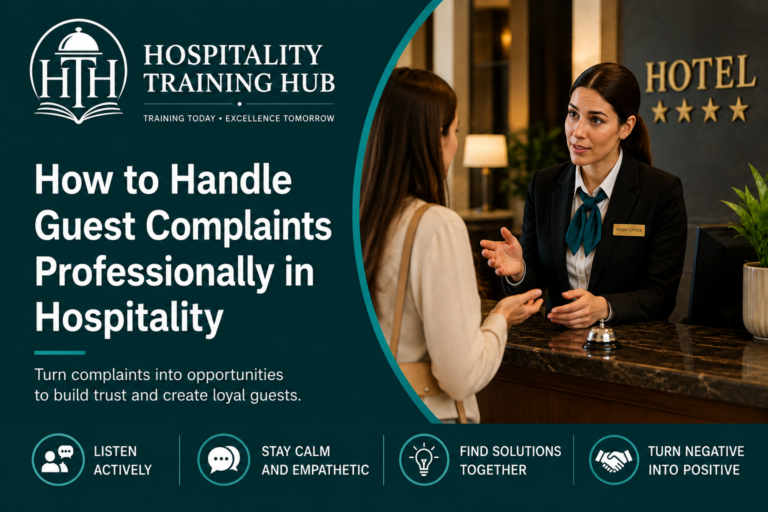
This is especially important when a guest has a question, special request, or complaint.
Avoid interrupting or assuming you already know what the guest is going to say. Instead, listen carefully, ask questions when necessary, and confirm your understanding.
Guests are much more likely to feel valued when they know someone has genuinely listened to them.
3. Empathy
Hospitality professionals interact with people from different backgrounds and in many different situations.
Some guests will be celebrating. Others may be tired after travelling, stressed, disappointed, confused, or frustrated.
Empathy means recognising how someone may be feeling and responding appropriately.
For example, when a guest experiences a problem, immediately explaining why it happened may be less important than first acknowledging their frustration.
A simple response that shows understanding can help build trust and make difficult conversations much easier to resolve.
4. Problem-Solving
Things don’t always go according to plan in hospitality.
Rooms may not be ready. Reservations can be incorrect. Orders can be delayed. Guests may make unexpected requests.
Strong hospitality professionals don’t panic when problems occur. They focus on what can be done to improve the situation.
Effective problem-solving involves:
- Understanding the problem
- Identifying possible solutions
- Knowing what you are authorised to do
- Acting quickly when appropriate
- Asking a supervisor or manager for support when necessary
The goal isn’t always to create a perfect solution. Sometimes it’s about finding the best possible solution while making sure the guest feels supported throughout the process.
5. Attention to Detail
Small details can have a surprisingly large impact on the guest experience.
Remembering a guest’s request, noticing that something is missing from a table, checking that an order is correct, or spotting a problem before the guest has to mention it can all demonstrate excellent service.
Attention to detail also helps create consistency.
Guests may not consciously notice every small thing that goes right, but those details contribute to an overall feeling of professionalism and quality.
6. Professionalism Under Pressure
Hospitality can be fast-paced.
Busy check-in periods, full restaurants, large events, staff shortages, and unexpected problems can all create pressure.
During these moments, maintaining professionalism becomes especially important.
Guests should not feel that they are a burden simply because the business is busy.
Professional hospitality employees learn to manage their emotions, prioritise tasks, communicate with colleagues, and remain calm when situations become challenging.
Staying composed doesn’t mean ignoring pressure. It means learning how to manage it without allowing it to negatively affect the guest experience.
7. Teamwork
Excellent guest service is rarely delivered by one person.
A hotel guest, for example, may interact with reservations, reception, housekeeping, food and beverage, maintenance, and other departments during a single stay.
If those teams don’t communicate effectively, the guest notices.
Strong teamwork means sharing important information, supporting colleagues, communicating clearly between departments, and understanding how your own role contributes to the wider guest journey.
When employees work together effectively, service becomes smoother and more consistent.
Great Customer Service Skills Can Be Developed
Excellent hospitality professionals are always learning.
Communication, empathy, problem-solving, teamwork, and the ability to remain professional under pressure all become stronger through practice, feedback, and training.
For hospitality businesses, investing in these skills can also help create more confident employees, stronger service standards, and more consistent guest experiences.
For hospitality professionals, developing these abilities can build confidence and create a strong foundation for future career progression.
Ultimately, great hospitality comes down to people — and giving those people the knowledge and confidence they need to deliver their best service.
Ready to Strengthen Your Hospitality Skills?
Develop practical skills and build the confidence to deliver professional, consistent service throughout the guest journey.
Explore Our Courses